April 15, 2026
Your Competitors Have an Identity Graph. You Have Ticket Numbers.
What grocery figured out, what McDonald's and Starbucks proved, and why the QSR operators building digital right now are making one of the most consequential bets in their industry.
By Jim Edgett
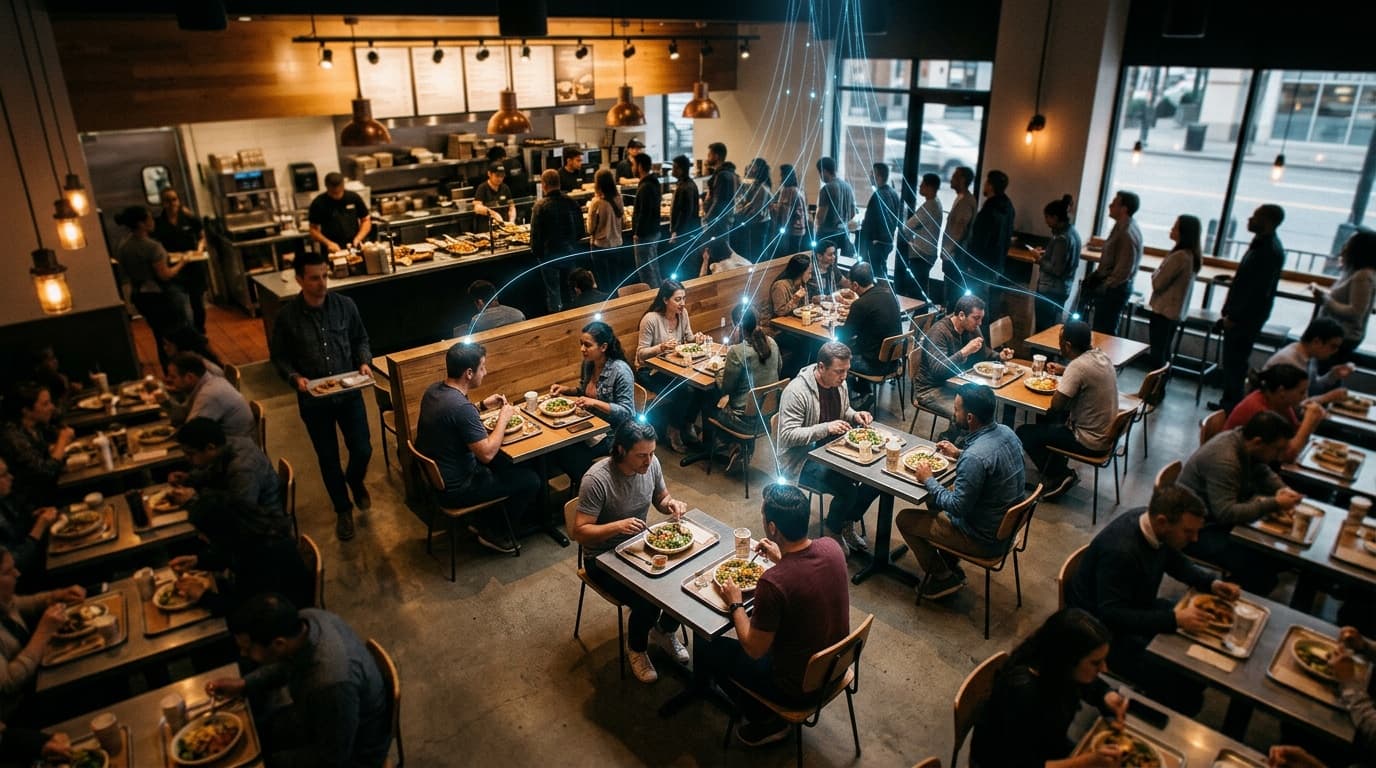
What grocery figured out, what McDonald's and Starbucks proved, and why the QSR operators building digital right now are making one of the most consequential bets in their industry.
Let me start with a lettuce problem.
For most of grocery's history, the category was completely anonymous. Someone walked in, grabbed a cart, paid cash or swiped a card, and walked out. The store had a receipt. It had no idea who just spent $87 or whether they'd be back next week. "We have no idea who bought the lettuce" wasn't a failure — it was just the reality of running a grocery store in 1995.
Then loyalty cards happened. Then e-commerce. Then apps. Gradually, grocery built an identity layer on top of their stores: a way to connect the cart to the household, the purchase to the person, the visit to the pattern. Kroger's 84.51° division now runs some of the most sophisticated customer analytics in retail. That identity layer is what made retail media networks possible — because once you know who bought the lettuce, you can sell that audience to the brands whose products they buy. Grocery TV alone now runs in more than 6,500 stores, reaching roughly one in four Americans with media that's targeted on real purchase history, not guesswork.
Anonymous lettuce turned into an audience. The audience turned into a media business.
That transformation took about two decades and is still accelerating. And the QSR industry is now facing a version of the same choice — with one critical difference. In QSR, you don't get to choose whether to compete with identity. Your competitors already made that choice for you.
McDonald's and Starbucks aren't just better funded. They're better informed.
McDonald's has spent billions over the past decade building the infrastructure of knowing their customers: app, loyalty, kiosks, cloud, AI. Digital now accounts for more than 40% of sales in many of their top markets, with quarterly digital sales running around $7 billion. They're deploying cloud-connected, AI-enabled platforms across nearly 43,000 restaurants.
My 20-year-old son lives in their app. He orders ahead, collects points, sees personalized offers, and walks into stores where the kiosk handles his order without friction. That's not marketing — that's a customer relationship that has been earned, structured, and maintained over time. McDonald's knows who he is, what he orders, how often he comes in, and what offers move him.
Starbucks built the same thing, arguably earlier. Their loyalty program and app created a direct customer relationship that most QSR brands would spend heavily to replicate. Stars, personalized recommendations, mobile order, stored preferences — it's all identity working.
Now here's the part that's easy to miss: when McDonald's pushes a personalized offer to my son at 11:45 on a Tuesday, they're not just trying to win his lunch. They're competing against every other option he has, with a data advantage none of those options can match. That advantage compounds every time he uses the app.
Your competition isn't just their food or their price. It's their identity graph.
The fight you're losing without knowing it
Here's what doesn't get said plainly enough: if you're a QSR operator without a strong identity layer, you are already behind — not in some future capability race, but in today's customer acquisition and retention fight.
A growing share of your revenue runs through DoorDash, Uber Eats, and Grubhub. Those platforms take 15 to 30 percent commission. But commission is only half of what you're giving up. You're also giving them the customer account, the behavioral history, and the relationship. When DoorDash recommends your restaurant to someone new, that recommendation is powered by data you will never see. When that customer reorders, they do it through DoorDash — not through you. You made the food. They own the guest.
That's a double tax: margin to the platform, and identity to the platform.
And ghost kitchens compound this further. More volume, more anonymous, more platform-dependent.
Now layer in something that almost nobody talks about in this context: word of mouth.
Friend recommendations drive more food decisions than any paid channel I'm aware of. "You have to try this place" is the highest-converting sentence in the restaurant industry. When a regular brings a friend for the first time, that is a signal worth everything — it's social proof, trust transfer, and acquisition in a single moment.
Without identity, you are completely blind to it. You can't see that it happened. You can't thank the person who brought someone new. You can't build a referral loop. You can't connect the social moment to the transaction. You can't even know which of your regulars are your best advocates.
McDonald's and Starbucks can. They close that loop. You're running your highest-value acquisition channel with no instrumentation at all.
This is where the industry is actually heading
Many QSR brands are in active "build digital" mode right now, and that's the right instinct. But how you build digital matters as much as whether you build it.
The operators who win this next phase won't just have apps and loyalty points. They'll have something more foundational: a live, first-party customer graph that connects transactions, preferences, social behavior, and channel history into a unified view. And increasingly, that graph becomes the basis for something even more valuable — data sharing and CRM-powered programs that create new revenue streams from the identity asset itself.
Grocery already proved this. The loyalty infrastructure that grocers built for customer retention became the foundation for billion-dollar retail media networks — CPG brands paying to reach audiences defined by real purchase behavior. QSR is early in that same arc. The brands building rich customer graphs now are positioning themselves for media, partnership, and data-sharing opportunities that don't fully exist yet but will.
The question isn't whether this shift happens. It's whether your brand is building the foundation now, or arriving late.
My argument: identity is the spine. AI middleware is the bridge.
Grocery shows what happens when you take identity seriously. McDonald's and Starbucks show what happens when you do the same thing in QSR with real investment and real commitment. My work lives in the middle: building a practical path for operators who will never have McDonald's budget but still need those outcomes.
The architecture I use is what I call intelligent middleware — an AI-powered orchestration layer that sits on top of what you already have. Not a replacement for your POS, your CRM, your loyalty platform, or your delivery feeds. A layer above all of them that makes them work together.
It ingests events from all your systems in near real time — transactions, app sessions, loyalty actions, delivery orders, media impressions, service contacts. It standardizes and resolves identity: stitches identifiers (app IDs, loyalty numbers, card tokens, emails, phones, delivery handles) into a governed customer view across channels. For multi-brand portfolios, it does this across brands, surfacing guests who are regulars at one concept but invisible at another.
It applies models and rules in one decisioning layer — churn risk, daypart preference, offer responsiveness, frequency caps, profitability guardrails. Then it activates: pushing next-best actions into CRM journeys, app or web content, SMS and email, paid media audiences, in-store kiosks, and service workflows. When an order is delayed, the middleware triggers service recovery before the customer has to complain.
And it measures. Closed-loop reporting against holdout groups, not vanity metrics. Model improvement built into the loop.
This doesn't require ripping out existing systems. It's designed to sit on top of a messy stack. And for multi-brand portfolios, it's especially powerful — because shared identity and decisioning is where the real competitive leverage lives.
Journey Gain recently worked with a regional coffee brand that came in with seven million rows of transaction data — and no idea who any of those customers actually were. We built an analysis environment to characterize the data, then proposed an identity resolution program combining our architecture with lightweight QR-based identity bridges on cups, bags, and receipts. The projection: 20% of transactions identified within 60 days, with enough behavioral signal to begin testing subscription plans for high-frequency customers. Anonymous transaction data to a testable revenue model, in under 90 days.
A practical roadmap for operators who are building right now
You don't have to be McDonald's to start walking toward McDonald's. Here's a 6-to-12 month path that's realistic.
Step 1: Name the gap honestly. Ask one question: what percentage of last week's transactions can we tie to a known person with some purchase history? If the answer is below 20%, name that out loud. Acknowledge that third-party delivery is a double tax — commission and identity, both going out the door. Acknowledge that your best acquisition channel (word of mouth) is currently invisible.
Step 2: Start listening. Get events into one place. The first move isn't buying a new platform. It's turning on event streams from your POS, digital ordering, loyalty (if any), and delivery feeds into a shared layer. This can start scrappily. The goal is one timeline of what's happening across your business. You probably can't see that today.
Step 3: Build cheap identity bridges. Use whatever identity resolution you have to start stitching the identifiers you already collect — app IDs, loyalty numbers, card tokens, emails, phones. Even 10 to 20 percent coverage is enough to start learning and improving.
At the same time, add low-cost identity on-ramps. QR codes on bags, cups, and receipts that link to genuinely useful content — ingredients, how it's made, a "thank you" offer, a "save your usual" flow. I did this with a bakery I co-owned: QR codes on product labels linking to our process and story turned a shelf product into a conversation and created an optional path to a direct relationship.
I ran a version at brand scale too: connecting Dick's Sporting Goods and TaylorMade Golf via QR codes on physical products at Dick's. The mechanic was simple — a QR code on a TaylorMade product in a Dick's store sent the shopper into a TaylorMade-controlled brand experience, including a window into the Kingdom, TaylorMade's flagship golf facility in Southern California where serious golfers get to design and test custom drivers.
What made this project interesting was that both brands won, but on completely different terms. Dick's KPIs were traditional retail — they wanted their customer engaged, their floor traffic activated, their brand associated with a premium experience they didn't have to build or pay for. TaylorMade's KPIs were about brand relationship and future purchase — they sell custom drivers direct, and getting a golfer into the Kingdom experience is how they build the kind of loyalty that leads to a $400 custom club order months later.
Same customer. Same QR scan. Two entirely different definitions of success, both achieved. That's what an identity bridge actually does at its best: it moves a transaction moment into an owned, brand-controlled experience that compounds over time. That is exactly the play QSR operators need to run.
Step 4: Let AI make a few obvious, measurable decisions first. Start with three models that are easy to explain and easy to measure: lapse risk (who hasn't come back on cadence), daypart preference (breakfast regulars vs. dinner), and offer responsiveness (who only moves on deep discounts). Use these to power a reactivation play, a daypart bundle, and smarter suppression in media — stop hitting guests who already converted. Run all of it against a holdout group. Show the number.
Once the measurement loop is working, you have the foundation for something bigger: a first-party data asset that supports not just better marketing but eventually the kind of CRM-powered data sharing programs that are becoming standard in grocery and will reshape QSR economics next.
Where this lands
Grocery proved that identity plus operations can turn anonymous shopping into a durable growth engine. McDonald's and Starbucks proved that the same is true in QSR — at scale, with sustained investment.
Most operators won't spend that way. But the choice isn't between McDonald's-scale transformation and doing nothing. There's a real path between those two: build identity bridges now, get events flowing, run AI against a small number of high-leverage use cases, and measure everything.
The operators who start that work in the next 12 months will have something the ones who wait won't: a real customer graph, a closed-loop measurement capability, and the foundation for the data-sharing and media programs that are coming for QSR whether the industry is ready or not.
You don't know who's eating there today. That's not a permanent condition. It's a choice.
Jim Edgett
Jim Edgett is the founder of Journey Gain. He previously ran loyalty, CRM, retail media, and customer data at GameStop, where he built PowerUp Rewards into a 65-million-member program and owned a $70M retail media P&L.